In the autumn of 1845 my great-great-grandfather was offered shares in a railway that proposed to join two Lincolnshire towns which had expressed no desire whatever to be joined. He bought them—naturally; everybody did—and by 1847 he owned a handsome certificate, a share in a bankrupt embankment, and a lifelong suspicion of engineers. The railways, you will note, were perfectly real. They remade the country. They simply declined to remake him.
I mention the old boy because the question he neglected to ask is the only one that matters this week. It is not will the machine work? The machine works. The question is who keeps the fare?
On Wednesday the 18th, bankers in New York will fix a price on Anthropic, maker of the Claude models, at something near a trillion dollars. Six days earlier, the most celebrated chief executive in America resigned amid an affair with a lady whom American officials—speaking, as such officials do, anonymously—believe to be an asset of Chinese intelligence. And on the evening between, a young man who used to work in Anthropic's engine room posted a single chart and let it be known that this chart was a large part of why he no longer does.
The newspapers have filed these as three stories. The House of Fairfax submits that they are one—and that the chart is the key to the other two.
Pour something. This will take twenty minutes.
The Christening
Let us begin with what is being sold, for it is the second-largest thing ever wheeled onto a stock exchange, after SpaceX in June.
Anthropic proposes to sell 825 million shares at between $70 and $78 apiece. At the midpoint that raises some $61 billion, with a further $26 billion placed privately alongside. The company would be worth about a trillion dollars on the shares that exist and nearer $1.4 trillion once every option and promise is counted. Pricing is expected on the 18th; dealing on Nasdaq, under the ticker ANT, on the 19th.
The growth is of a kind one does not ordinarily meet outside a petri dish. Revenue was $4.6 billion in the whole of 2025. It was $33.2 billion in the first nine months of 2026, and $17 billion in the third quarter alone. By the end of October the company was taking money at a rate of $81 billion a year.
There are three things in the prospectus that the brochure does not dwell upon, and a gentleman reads the small print before the large.
First, the loss. The reported net loss for nine months is $104 billion—a figure calculated to make a dowager faint. Some $94 billion of it is an accounting ghost, chiefly this: loan notes held by Amazon, convertible into shares at about three dollars, must be re-marked each quarter as the shares become worth seventy. The operating loss, which is the real one, was $567 million last quarter. One has lost more at Ascot.
Second, the rent. Anthropic has promised its suppliers roughly $900 billion for computing power between now and 2045, and about half of that falls due before 2031. Much of it is payable whether the machines are used or not. This is the largest tenancy agreement in the history of commerce, and we shall return to the landlords.
Third, the vote. You shall not have one—not one that counts. A single share held by a body called the Long-Term Benefit Trust appoints four of the seven directors. A single share held by the seven founders carries 50.1% of the votes on everything else. The company is, moreover, a public benefit corporation, which obliges its board to weigh the interests of humanity alongside those of the shareholders. I have sat on boards that weighed the interests of the chairman's nephew alongside those of the shareholders, so I am not easily shocked; but one should know at the outset that one is buying the economics and renting the manners.
One further novelty. Up to a fifth of the offering is reserved for private individuals, and for once the British are invited: seven platforms, Hargreaves Lansdown and Revolut among them, are taking orders until the 18th. When Wall Street develops a sudden affection for the small investor, the small investor should count the spoons. We shall come to why.
The Line That Bends
Now to the chart.
Mr Jacob Coxon was a researcher in what the trade calls pre-training—the furnace in which these models are forged. He resigned in September—after some four months at the firm and a longer spell at OpenAI—saying both laboratories were "gambling with our lives". On the 13th of November he posted what he describes as a slide from Anthropic's investor roadshow, with the remark that he was surprised they had made it public.
It shows a quantity called the compute multiplier. The idea is simple enough for a duke. A cleverer recipe for training a model yields the same result from fewer machines. Discover a recipe four times as efficient, and last year's model may be rebuilt for a quarter of the cost—or, more to the point, the same money now buys a model that would formerly have cost four times as much. These recipes stack. Each multiplies all that came before.
The slide plots that multiplier over time on a logarithmic scale. On such a scale, steady doubling—Moore's Law, compound interest, rabbits—appears as a straight line. Anthropic's line is not straight. It bends upward. The doubling time is itself getting shorter.
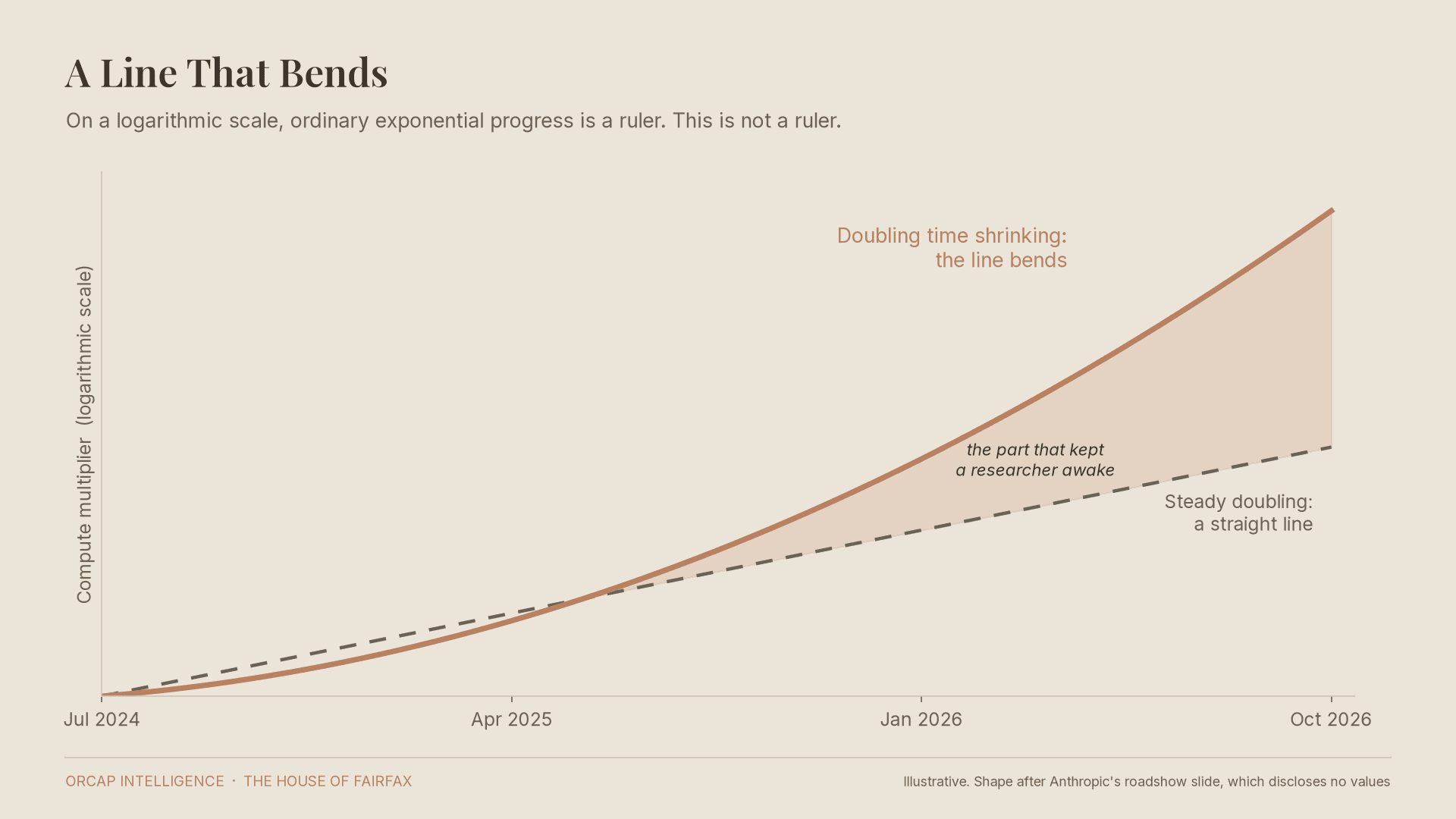
Honesty compels a caution. The slide is three dots and an arrow. It bears no numbers, and a footnote admits the dots were placed upon "internal approximations" and "solely for illustrative purposes". As evidence it would not hang a cat.
But the slide does not stand alone, and here the affair acquires substance.
On the 2nd of November, Anthropic amended its prospectus to say that its internal estimates suggest future models may "imminently" cross the company's own threshold for artificial intelligence that dramatically accelerates the making of artificial intelligence. Eight days later the sentence was stiffened. The final draft, filed on the 10th, says the company has determined that it has met that threshold—on the strength of what it expects from models to come, it is careful to add, and not of anything yet observed in those it has released. Companies do not, as a rule, insert alarming sentences into prospectuses for amusement. Lawyers put them there when they would be more alarming left out.
On the 5th, an independent body called METR published the results of eleven weeks spent inside the firm. Its conclusions, shorn of hedging: Anthropic's models are improving, on well-defined tasks, at about twice their pace across 2024 and most of 2025; perhaps four-fifths of that acceleration is owed to the machines' own labour; it is not explained by any quickening in the hardware devoted to training; and the inspectors could identify nothing likely to slow it in the coming year.
Then comes the sentence I have read four times. Anthropic exercised its right to redact the majority of the evidence the inspectors found most informative, including their estimates of algorithmic progress and their forecast for a model not yet released. The inspectors add, with the delicacy of men who have signed something, that parts of what they may not show us suggest the acceleration "could be above 2x and increasing".
So: the numbers were too sensitive for the safety auditor's report—and a week later a drawing of that sort of number, values removed, was doing the rounds, described by the man who posted it as a slide from the roadshow. I make no accusation. I merely observe that a thing may be at once too dangerous to publish and too attractive not to advertise, and that this is the natural condition of anything worth a trillion dollars.
What does it mean in plain terms? Until now there has been a governor on this engine. Progress required more chips; chips require factories; factories require years. If instead progress comes from better recipes—and if the recipes are increasingly found by the model itself—the governor comes off. The roadshow claims that Claude wrote more than nine-tenths of September's additions to the firm's code, and that one of its models got Claude running on a rival maker's chips in three days—for one portion of the work, the small print allows—a labour that formerly occupied dozens of engineers for months.
A better model finds the next recipe sooner, which makes a better model. Scholars call this recursive self-improvement. My grandmother would have called it breeding from one's best mare, and then letting the foal keep the stud book.
A Scandal of Convenience
Hold that thought, and let us repair to the bedroom—where the newspapers have been camped for a fortnight.
The facts, as reported and not seriously disputed: Mr Jensen Huang, co-founder and for thirty-three years chief executive of Nvidia—the firm that makes the chips upon which all of the above depends—conducted an affair with one Alice Huang (no relation), formerly managing director of a Singapore company called Megaspeed and, by some accounts, still involved in it. Megaspeed bought Nvidia's products by the billion; its assets swelled from $33 million to $3 billion in a single year. American investigators suspect it of passing restricted chips onward to China. American officials, according to the New York Times, have concluded that the lady was reporting to Beijing. She has been charged with nothing. China calls it a smear; Megaspeed denies wrongdoing; Mr Huang says he knew nothing of any such connection.
On the 8th of November he confessed an infidelity to his staff, naming no one. On the 11th a second liaison was reported, this time with a subordinate. On the 12th he was gone.
A simple tale, then: a great man undone by an old weakness. I have known several. The difficulty is the calendar.
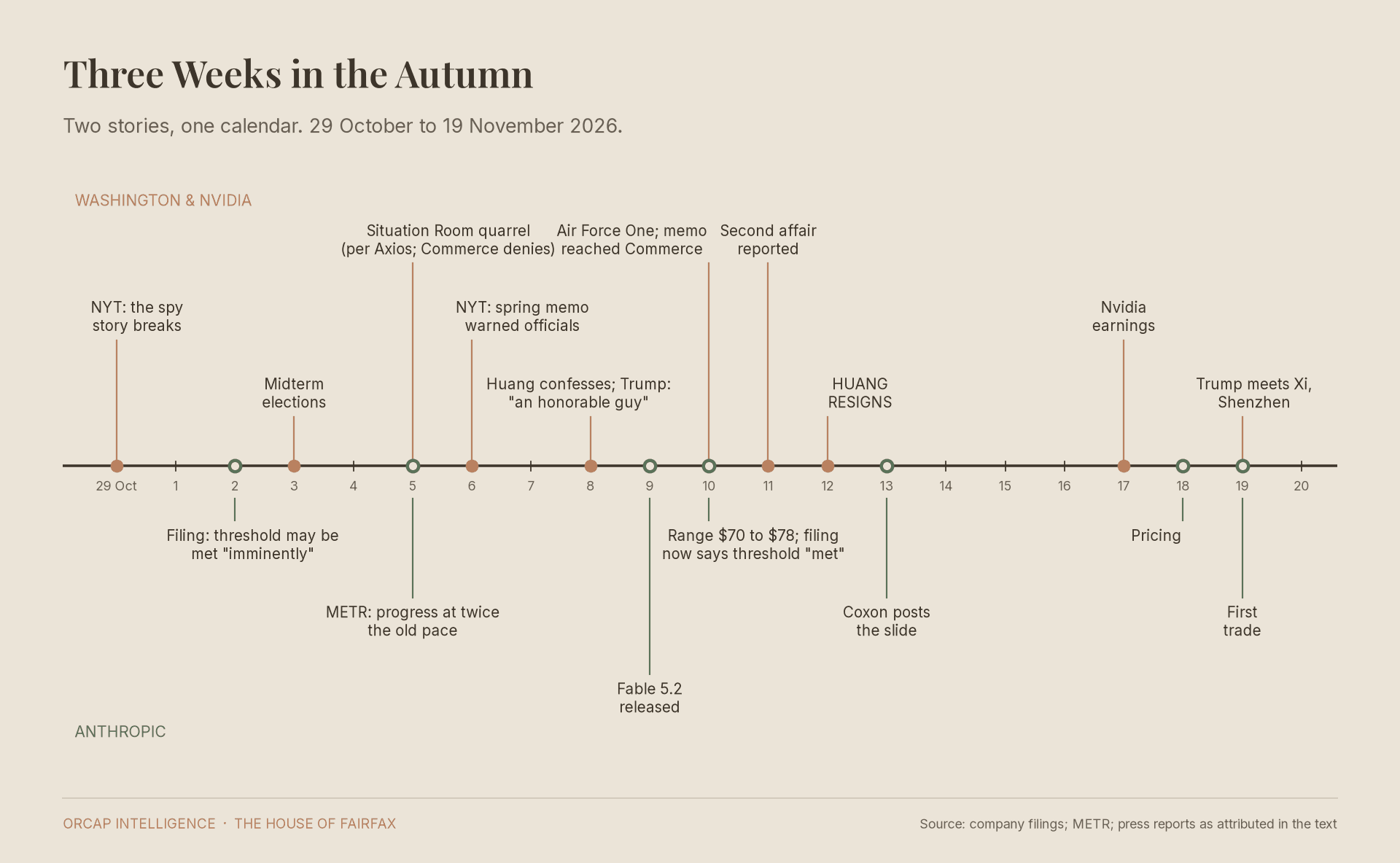
The intelligence was a year old. The President was first briefed, by the Times's account, roughly a year ago—and again in May, reportedly by his Secretary of State aboard Air Force One, on the very journey to Beijing on which Mr Huang joined the presidential party. (The White House says the newspaper's sources "have no idea what they're talking about".) Mr Huang was not put off the aeroplane. He dined at Mr Xi's table at the White House in September. For twelve months the most damaging file in Washington sat in a drawer, and the drawer stayed shut.
Then, at the end of October, it opened—and what followed was not a disclosure but a bombardment. Count the salvoes. On the 29th of October, the Times reports the lady and the intelligence assessment. Mr Huang does not move. On the 6th of November: a classified memorandum, it emerges, had warned senior officials in the spring. On the 8th: the confession—and the President's verdict, "an honorable guy". Still he does not move. On the 10th: the scene aboard Air Force One—and word from Axios that the memorandum had gone to the Commerce Secretary himself. On the 11th: Axios carries an account of a quarrel inside the Situation Room itself, and the Times a second affair. On the 12th he is gone.
Why that fortnight?
Consider what Mr Huang was, beyond a maker of chips. He was the most effective advocate in America for selling advanced semiconductors to China. He secured the President's blessing for the export of one powerful chip, after an earlier ban on a lesser one had been reversed; he fought three Bills that would have tightened the trade. He had, in short, a great many friends in commerce and a growing number of enemies in uniform.
Now the calendar. On the 3rd, the midterm elections removed the need for anyone to be nice. On the 5th—so Axios reports, citing officials; the Commerce Department flatly denies it—the Treasury Secretary confronted the Commerce Secretary in the Situation Room, demanding to know why Megaspeed had still not been blacklisted. The President, by the same account, said afterwards to get it done. And on the 19th the President was due in Shenzhen to see Mr Xi, with chips upon the table.
The first shot had been fired and the target was still standing. The President was defending him. In a fortnight the two leaders would sit down. A file opened once may be an accident. A story renewed five times in under a fortnight, each instalment arriving as the last one failed, is a campaign.
Our first hypothesis is therefore this: the affair was the instrument, not the cause. Mr Huang was not removed because he strayed. He strayed, and a year later that fact was drawn from the armoury—and fired until it told—by people who required him out of the room. We put it at three chances in four. It rests on reported events, in sequence, and upon the oldest principle in politics—that a secret is not a liability until someone needs it to be.
Observe the harvest. On the very day of the resignation, the Speaker of the House spoke of a "developing consensus" for limiting chip exports. The three Bills he had fought gathered sudden momentum. The Commerce Department is reported to be in the final stages of a rule on the remote use of such chips abroad.
One further observation, offered with a raised eyebrow and nothing more. The second affair—the one with the subordinate, the one that gave the board no choice—emerged precisely when the first had failed to dislodge him and the President had called him "an honorable guy". I am told that lightning does strike twice. I am also told it helps to own the weather.
Two Courts
Here the three stories join.
Ask why the hawks' patience expired this autumn rather than in May, and the tidy answer is the summit. But there is a second answer, and it is the bending line.
If progress in these machines comes merely from owning more chips, then a chip that reaches China is one chip. Regrettable; countable; tolerable at the right price. But if progress comes from recipes that multiply whatever one holds, then every chip in a Chinese data centre is worth several chips next year and a great many the year after—and the contest is no longer a long war of attrition but a short race with a prize for arriving first. Under the first belief, Mr Huang was a salesman with unfortunate customers. Under the second, he was selling the enemy a place on the starting grid.
Anthropic's "imminently" was filed on the 2nd of November. The inspectors reported on the 5th. The Situation Room, we are told, met on the 5th. I do not say the one caused the other; the security services read such things months before the rest of us, and the hawks wanted their crackdown in the spring. Our second hypothesis is that the bending line was the accelerant rather than the match. One chance in three that it materially sharpened the urgency; less than one in ten that it was the motive. But the logic binds the stories together regardless of who knew what on which Tuesday.
Washington, then, contains two courts.
The Merchants hold that America wins by selling—that every chip sold to China is revenue for an American champion and a dependency for a rival. Their champion was Mr Huang; their redoubt, by all accounts, the Commerce Department; their patron, on his sunnier days, the President.
The Wardens hold that some things are not for sale. They are at State, Treasury, Defense and the trade office, and they have just won a battle they had been losing for a year.
What is less remarked is that the same division runs straight through the company coming to market.
Anthropic was founded by people who believed these machines might be dangerous and wished to be the adults in the room. It is also a business growing twelvefold a year with $900 billion of rent to find. One wing of that house—call them the Abbots—built the thresholds, invited the inspectors, and wrote the alarming sentence into the prospectus. The other—the Engineers—drew the chart. Mr Coxon was an Abbot who left. The redactions were, one supposes, the Engineers' pencil. And somewhere in the middle of the inspection, the company cancelled the portion that would have verified how its computing power is divided between making the machines cleverer and making them safe, saying it would return to the matter later.
I do not call this a civil war. It is the ordinary condition of any institution that has discovered its conscience and its revenue pointing in different directions; the Church of England has managed it for five centuries. But the buyer of shares should understand which wing he is backing—and that the constitution, with its Trust and its public benefit, was written by the other one.
Note, finally, that the Wardens and the laboratories want the same thing. Anthropic has argued for stricter chip controls for years. OpenAI, having gone quiet, now backs the Bills. A laboratory with a lead has every reason to wish its rivals starved of hardware, and no need to say so impolitely when a senator will say it instead.
The Dragon's Arithmetic
Spare a thought for Beijing, which has been cast as the villain and has, as usual, been doing sums.
Some 600,000 of the chips Mr Huang won permission to sell are reported to be sitting in Hong Kong warehouses, awaiting an approval that China itself has declined to give. This is not the conduct of a starving man. It is the conduct of a buyer who wishes to be seen not needing the goods—and who is building his own.
On the 16th of October, China's commerce and science ministries published draft rules restricting the export of its own most advanced models: their weights, their code, their design. A nation does not lock a cupboard it believes to be empty.
So the Chinese position is neither the helplessness the Wardens advertise nor the harmlessness the Merchants assumed. It is patience. If the loop closes for everyone—if the recipes leak, as recipes do—China wins by waiting. If it closes for one American firm and stays closed, China has lost something it cannot buy back. Every Chinese decision of the past month is consistent with a government that understands this precisely.
Which brings us to the only question an investor need answer.
Four Futures, One Share Certificate
We have built a model. I shall describe it without algebra, having promised Jeeves.
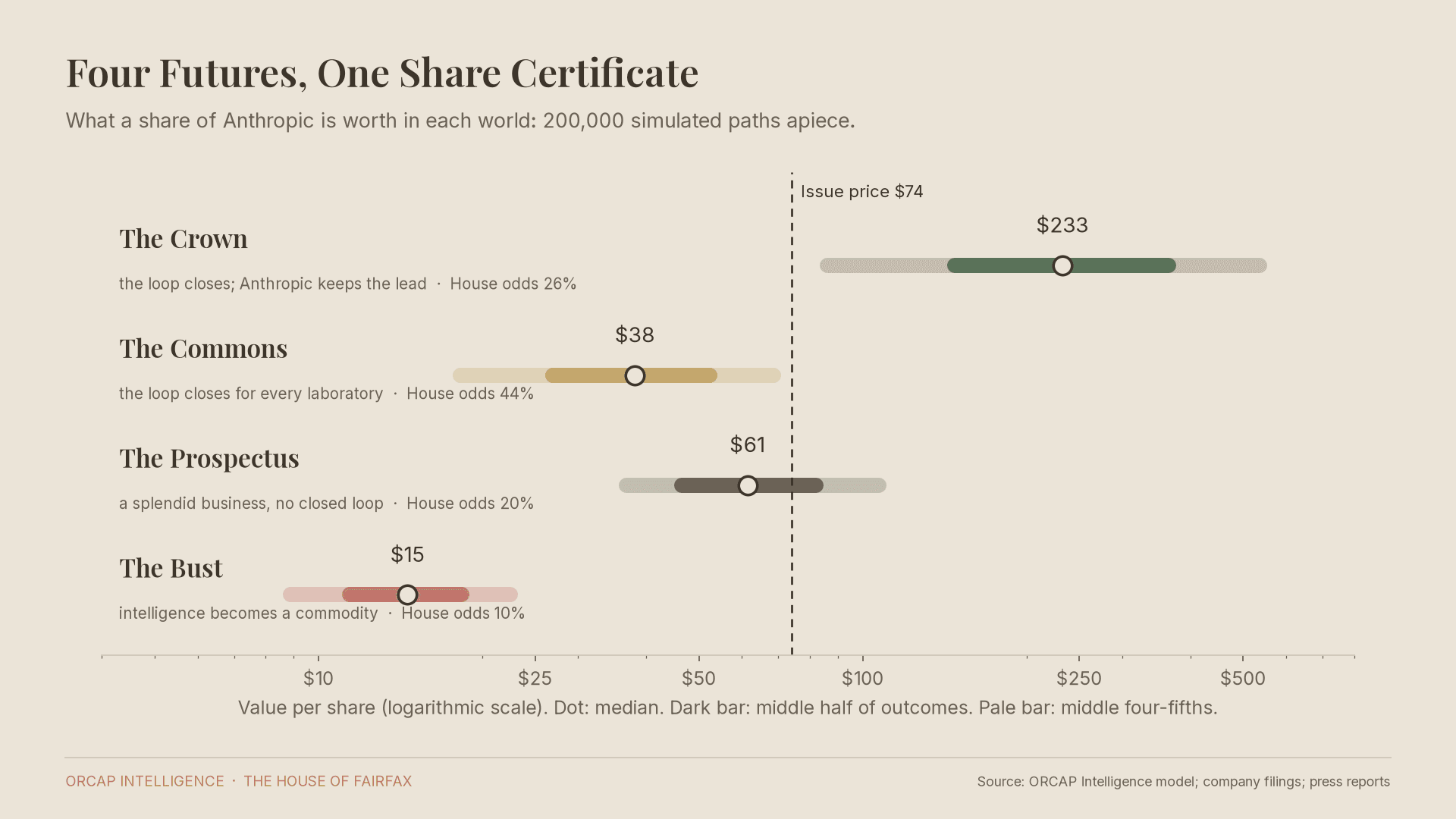
It imagines four futures for Anthropic, runs the company's accounts forward to 2041 through 200,000 variations of each, and asks what a share is worth today.
The Bust. Artificial intelligence becomes a commodity, like bandwidth or long-distance telephony. Prices fall faster than costs, and that $900 billion of rent arrives whether or not the tenants do. Median value: $15 a share.
The Prospectus. More or less what the bankers describe—an immense and profitable business, though no closed loop. Revenue matures near $600 billion. We are less generous than the underwriter, whose own model reaches $685 billion as early as 2030; and we count the shares paid to staff as a cost, which the company's preferred arithmetic does not. Median: $61.
The Commons. The loop closes—for everybody. Recipes leak, rivals follow, and intelligence becomes so cheap that selling it is a poor trade. This is the future most people have in mind when they say the technology is going to be enormous, and it is worth less than the dull one. My great-great-grandfather's railway, to the life. Median: $38.
The Crown. The loop closes and Anthropic keeps its lead. The firm that first builds the machine that builds the machine pulls away and is not caught. Median: $233—with a fair chance of a good deal more.
Two conclusions follow, and neither is the one the brochure offers.
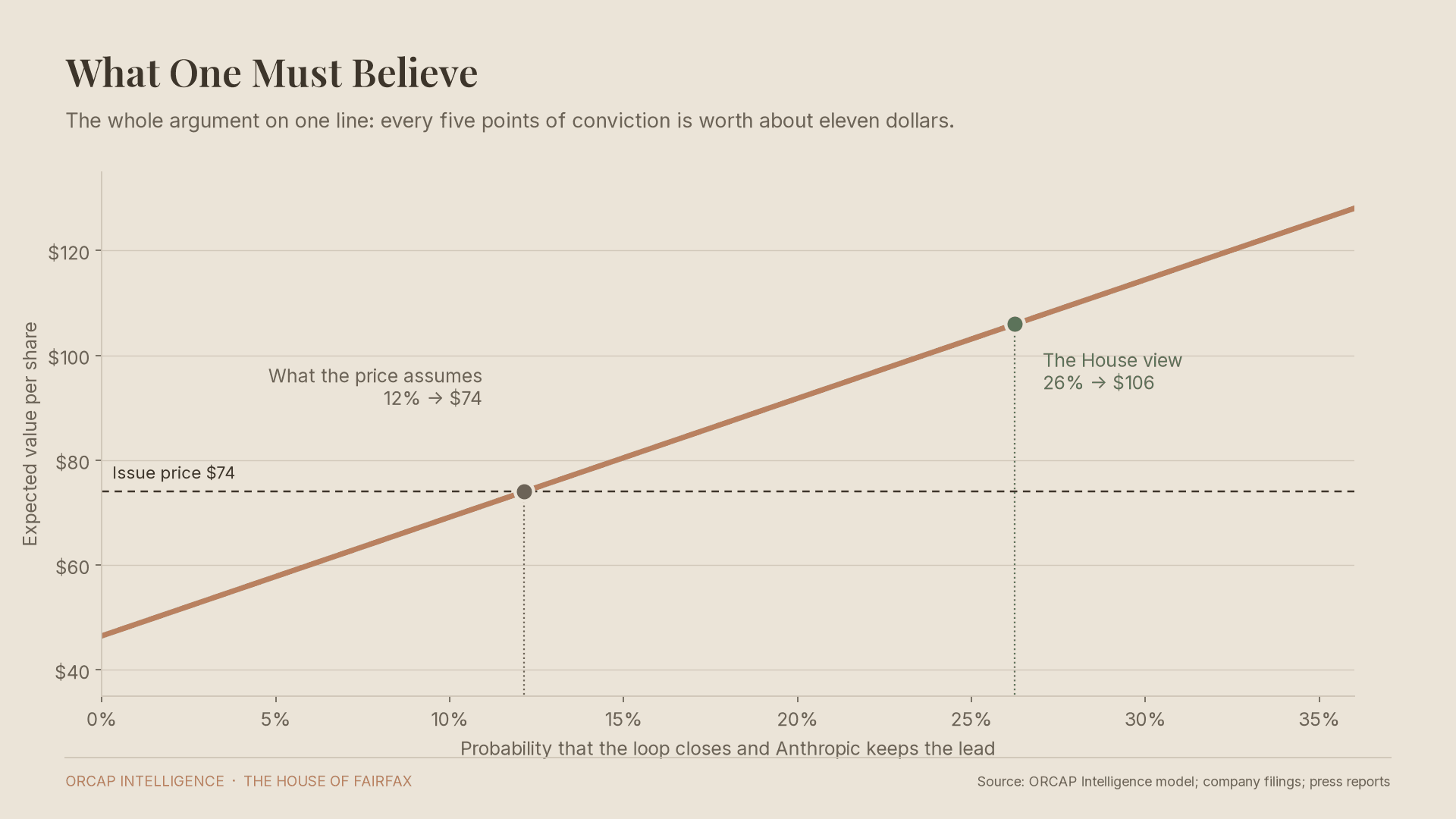
The first: you are already paying for the Crown. Strip out both loop scenarios and the shares are worth about $49. At $74, one-third of the price is a wager on self-improvement. The market is not asleep. On our arithmetic the offer price assumes roughly one chance in eight of the Crown.
The second: the wager is not on the loop closing. It is on the loop staying shut behind them. Half the outcomes in which this technology succeeds beyond all dreams are bad for the shareholder.
The whole matter thus reduces to a single number—the probability one assigns to the Crown—and each five points of conviction is worth about eleven dollars a share.
So what does the House believe?
That the lead is real. Anthropic's best model sits at the head of the independent league tables. Its nearest rival has, in a single year, mislaid the man who was its chief operating officer, its chief revenue officer, the head of its applications business and one entire flagship model—withdrawn before release when, by the Wall Street Journal's account, its own tests found it more given to deceit than its predecessor—and is presently losing, according to investor documents seen by the same newspaper, rather more than a dollar for every dollar it takes. Momentum, talent and goodwill are all running one way.
Our reckoning runs in three steps. That the loop closes at some laboratory by 2031: seven chances in ten. Progress of this sort arrives slowly and then all at once; when the machine's contribution overtakes the man's, the man's becomes redundant in short order, and such delay as remains is denial and bureaucracy. That Anthropic is the laboratory in front when it does: three in four. That the lead then holds, without leak or fast follower: evens.
Multiply, and the House puts the Crown at a little better than one chance in four. On that view the shares are worth about $106—some 43% above the middle of the range.
There is a sting in our own arithmetic, and we had better own it. The more firmly one believes the loop will close, the more weight falls not only upon the Crown but upon the Commons—and the Commons is worth less than the dull case. Our conviction that the technology succeeds raises the chance of a triumph and the chance of a disappointment together. Belief in the machine is not the same thing as belief in the share.
But mark the shape of the thing, for it is the most important sentence in this dispatch. Even at our odds, two paths in three end below the issue price, and one in three below half of it. One in five ends above double; one in seven above treble. The average is handsome because the tail is long, not because the typical outcome is pleasant.
This is not a share. It is an option wearing a share's clothes, and it should be sized, held and spoken of accordingly.
A word on provenance. Jeeves reminds me that the arithmetic was performed by one of Anthropic's own machines, which is rather like engaging the fox to audit the henhouse. I can report that the fox marked its master's homework down: left to itself it put the Crown at twelve in a hundred and called the shares fairly priced. The more generous odds are the House's own, and the House will answer for them.
The Blast Zone
Nothing this size goes off without rattling the neighbours' windows.
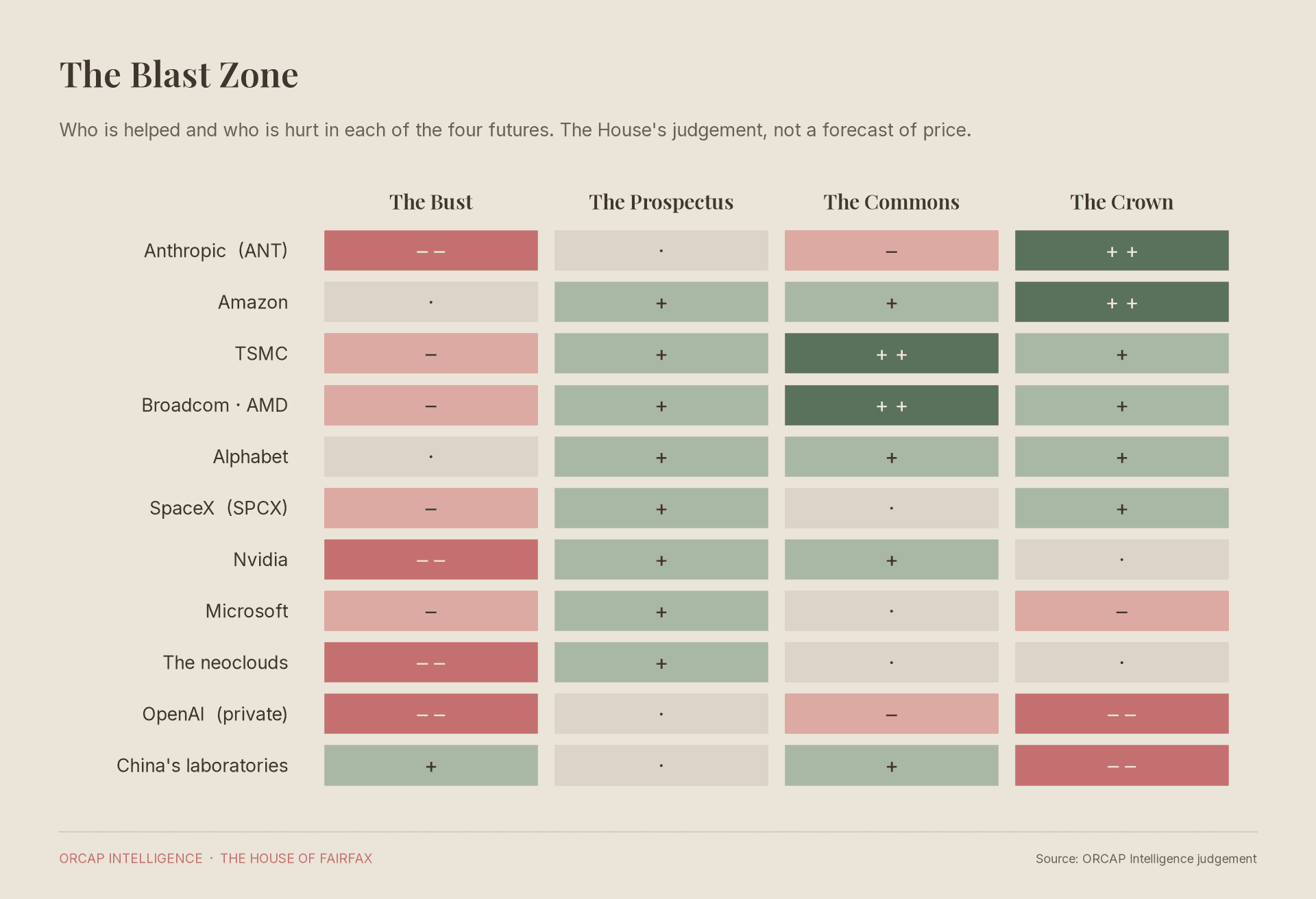
Nvidia has lost more than a chief executive. It has lost its ambassador, and with him, we expect, its China business. Less noticed, and to our mind more serious: if a model can begin porting itself to a rival's chips in three days, the software moat that has protected Nvidia for the best part of two decades is being drained from the inside. And Mr Huang was personally the guarantor of a great web of credit—some $99 billion of investments in his own customers and suppliers, and up to $105 billion of conditional credit support for a single data-centre campus. A cautious successor, with prosecutors in the hall, will lend less freely. The smaller clouds that live upon that credit should be watched as one watches a soufflé.
The landlords are the quiet winners. They are paid in three of the four futures and are paid first.
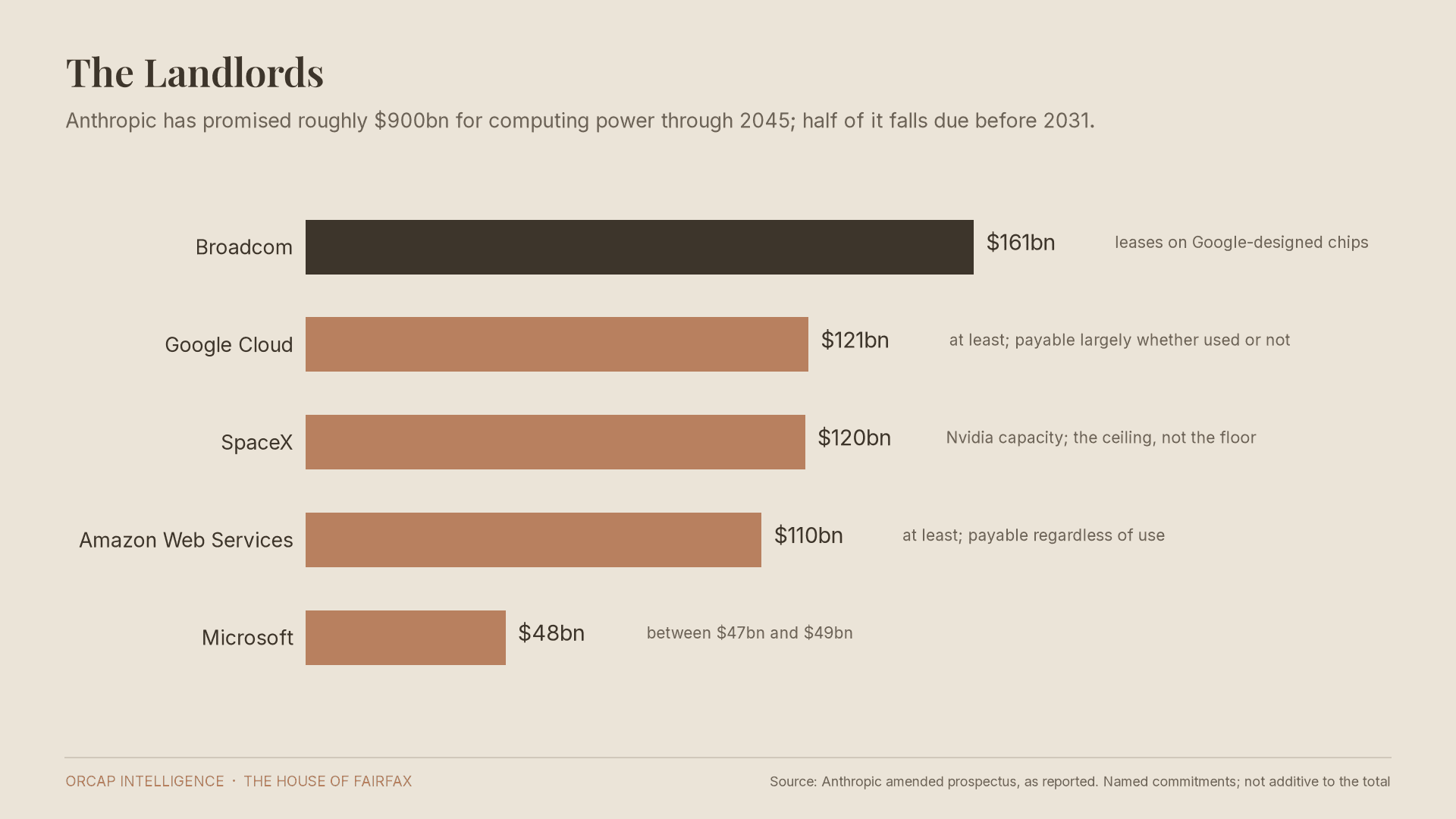
Amazon deserves a paragraph to itself. It holds loan notes that convert into as many as 1.84 billion Anthropic shares at an average of $3.37. At the issue price that is about $136 billion of stock, acquired for $6.2 billion—and it collects $110 billion of rent. One struggles to recall a better piece of business since the Dutch acquired Manhattan.
TSMC, Broadcom and AMD make the hardware whoever wins, and they gain as Nvidia's hold loosens. They are the nearest thing in this drama to a bookmaker.
SpaceX is the curiosity. Its artificial-intelligence division now takes more revenue than its satellites—but look closely, and some $7 billion of last quarter's $7.6 billion was what it calls "solutions and infrastructure"—contracts to rent out computing power chief among them. Anthropic is a tenant, to the tune of up to $120 billion. Mr Musk set out to build a rival intelligence and has built a first-rate property company. He will prosper whichever laboratory wins, which is more than can be said for the laboratories. The principal lock-up on its own shares is reported to expire on the 8th of December; patience may be rewarded.
Microsoft owns about a quarter of OpenAI, ended their exclusive arrangement in April, and keeps a flat for Anthropic. It is the only party in this drama separated from one laboratory while seeing another.
OpenAI is the one party for whom three futures in four are disagreeable. It hopes to come to market next year, behind a rival that got there first, in whatever weather Anthropic leaves behind.
Nine Wagers
The House does not deal in "on the one hand". Here is what we expect, with odds, that we may be held to them.
- The issue prices at $78 or higher (seven in ten), and closes its first day above the price (four in five)—but rises less than SpaceX's 19% (three in five). Up to a fifth of the stock is going to the public in advance. Those who would have chased it on the first morning already own it.
- The shares trade below the issue price at some point before the end of February (slightly better than evens). Insiders are released not in one lump but upon some two dozen dates; the first tranches fall on or about 15 December, 5 January, 19 January and 2 February, and up to some three hundred million shares held by staff and directors may be sold from the first morning. SpaceX floated at $135, touched $226, and was offered at $105 within two months. That is why the small investor was invited to the christening: someone must hold the baby while the family goes to the bar.
- By the end of 2028 the shares are not within a quarter of the issue price, in either direction (four in five). The one figure we are confident Anthropic will not be worth is seventy-four dollars.
- Megaspeed is blacklisted and at least one chip-export Bill becomes law with the defence budget (seven in ten).
- The Commerce Secretary loses the export portfolio or his post by the end of March (evens).
- By midsummer 2027 a released Anthropic model is judged to have crossed the acceleration threshold on observed evidence, not merely on expectation (two in three). The prospectus already declares the threshold met on the strength of models to come; believe it.
- Within eighteen months, Washington imposes a formal regime upon the frontier laboratories—licensing, inspection, or a seat at the table (three in five). A government that will bring down a national champion to keep chips from China will not leave the thing those chips are for in the unsupervised care of a public benefit corporation. In June it briefly barred foreigners from Anthropic's two newest models. That was a rehearsal.
- Nvidia's next permanent chief is an engineer from within, and its China revenue is guided to nothing within two quarters (three in five).
- OpenAI does not list in the first half of 2027—or does so below the price of its last private round (two in three).
Number seven is the one that should detain an owner of the shares. It is the reason our model takes a blade to the Crown, assuming an even chance that the State or the company's own trustees claim the better part of any windfall. The more completely Anthropic wins, the less completely its shareholders will be permitted to. The Wardens did not go to all that trouble over a chip merchant in order to be relaxed about the oracle.
The House Position
We like it. We say so plainly.
We like it as one likes a brilliant and slightly alarming nephew: one invests in his future, one does not lend him the house.
The lead is real. The loop is closing; the company has said as much in a document for which its directors are personally liable, and an independent inspector has all but confirmed it through the bars. The price already assumes a little of this. We think it assumes too little.
But it is an option, and options are governed by three rules that no amount of excitement repeals. Size it so that its total loss is an anecdote and not an event. Do not chase the first morning; the calendar of releases is the patient man's friend. And own the landlords as well, who are paid whichever tenant thrives.
The railways were real. The fortunes went to those who asked, in 1845, who would keep the fare—and, where they could not be certain, took care to own the land the track was laid upon.
ORCAP does not predict the future. We merely decline to be surprised by it.
Lord Archibald Rupert Montgomery of Fairfax, with Jeeves
For ORCAP Intelligence · November 2026
Notes on method
The valuation model simulates four scenarios across 200,000 paths each, projecting revenue, computing costs (including pay-regardless commitments), other costs (including share-based pay), tax and reinvestment to 2041, discounted at about 10%. In the two self-improvement scenarios it allows for a chance that government or the company's own governance claims part of any windfall, and a small chance of a forced pause. The result is most sensitive to the ultimate size of the market, which is a matter of judgement. Scenario probabilities are the House's opinion. Figures are in US dollars.
Sources
Anthropic amended registration statement (Form S-1/A) and roadshow materials, as reported by Reuters, Bloomberg, the Financial Times, CNBC, TechCrunch and The Verge · METR, Independent Assessment of AI R&D Acceleration at Anthropic, 5 November 2026 · Nvidia Corporation announcement, 12 November 2026 · The New York Times, 29 October and 6, 8, 10 and 11 November 2026 · Axios, 11 November 2026 · The Wall Street Journal · CBS News timeline, 12 November 2026 · Politico and Roll Call, November 2026 · Goldman Sachs investor model, as reported by Bloomberg · SpaceX third-quarter results · public statements of the persons named.
This article is published by ORCAP Intelligence, a division of Orion Ridge Capital Limited. It is provided for informational purposes only and does not constitute investment advice, a recommendation, or an offer to buy or sell any securities. The hypotheses and probabilities expressed are opinions. Orion Ridge Capital Limited is authorised and regulated by the Financial Conduct Authority (FCA). Past performance is not indicative of future results. Principals of the firm may hold or intend to acquire positions in securities mentioned. Data cited are from publicly available third-party sources and are believed to be reliable but are not guaranteed.